

Showing posts with label freebies. Show all posts
Showing posts with label freebies. Show all posts
Literacy Center: Silly Synonyms Game

Treasure Hunt: Map Activity & Science Experiment

Setting & Attaining Goals with your Students

Drive-Thru Menu Math Stations

What You'll Need
Menu
- Get your hands on any of our Menu Math activity books that come with full color menus, and that means no prep necessary. Plus, they are packed with reproducible practice pages and come in multiple levels.
- Snap a picture. Next time you're at your favorite drive-thru restaurant, take a picture of the menu, print it, and then laminate.
- Make your own kid-friendly menu.
Chairs, four per station
Set-Up
Create several stations, or let's call them "restaurants," throughout your classroom. At each restaurant have a menu (or a few copies of the menu for each student), pencils, and paper. Split students into groups of four or five, but no more than five. Assign one student per station to be the cashier; this student will take the orders.
These Activities are Absurd!

The funny thing about absurdities is that they entertain and build thinking skills. Absurdities are a key component of humor. Because they are fun, absurd activities can turn a reluctant learner into an eager student. And we all need a little more humor in our lives!
But absurdities have a serious side too! They are an effective teaching tool for problem solving and decision making. Students become more aware of the need to analyze the logic in something and apply common sense reasoning to communication. As students do this, their skills in making judgments and finding solutions increases.
These fun, clever, and absurd activities will improve students' critical thinking skills!
Fall is Here!

How to Read Mysteries with Your Students

PART 2: How to Read Mysteries with Your Students
Use this mystery story <free download> from one of our Mini Mysteries books to practice the following steps.
- Predict: Have students review the title, the synopsis on the back of the book, the cover of the book, and the pictures within the story. Ask students to write down what they predict the mystery will be about.
- Read: You may want to read the mystery to your students to test their listening ability, or students may read the stories to test their own logic skills. A combination of both may prove to be the best approach.
Tip: If you hand out copies or post the story on your whiteboard, only give students small segments at a time so they don’t read ahead.
- Investigate: Ask students to listen for interesting facts and clues.
· If you’ve given students a copy of the mystery, then ask them to highlight facts that give clues. Or have students write down the clues and the paragraph or page number they are found on. Tip: At the end of the story, have students go back to their notes and label each clue. Was it a useful clue or a red herring?
· Have students write down or underline the names of possible suspects. As they continue to read, students can make notes next to each suspect: the suspect’s alibi, motives, evidence, etc.
Why should your students read mysteries?

PART 1: Why should your students read mysteries?
High-Interest
Mysteries will get and keep your students’ attention! No matter what age, your students will want to solve a good whodunit. Mysteries introduce protagonists like detectives, inspectors, and even pre-teen girls and antagonists from all walks of life. And because an unsolved mystery can take place anywhere, this awesome genre will take your students all over the world.
Mysteries will get and keep your students’ attention! No matter what age, your students will want to solve a good whodunit. Mysteries introduce protagonists like detectives, inspectors, and even pre-teen girls and antagonists from all walks of life. And because an unsolved mystery can take place anywhere, this awesome genre will take your students all over the world.
Critical Thinking & Deductive Reasoning
Making Inferences - Using Logic – Predicting Outcomes
When reading a mystery, students must use facts and reasoning to come to a decision or an opinion. They’ll use logic to analyze the mystery, evaluate possible solutions, and follow sequential steps to arrive at a conclusion. These same steps are required in any problem-solving situation both academic and practical. Students will develop abilities in examining information, exploring possibilities, and sequencing.
Use our Story Map <free download> to help students come to a logical conclusion when reading.
5 Crafts & Experiments using Recycled Soda Bottles
We know you save every empty shoebox, paper towel roll, and soda bottle just in case the right class project or craft comes along. So let us help you put those hoarded 2-liter soda bottles to work!
Start by removing the labels and the sticky residue left behind. The trick is soaking the bottles in warm water, which will get most of the label off, and then using either white vinegar or peanut butter (yes, peanut butter—smooth, not chunky) to remove the sticky residue.
 Worm Farm
You will need a 2-liter bottle, 16-ounce water bottle (empty), sand, dirt, rocks, worms, tape, and black construction paper. Cut the tops off of the two bottles. Be sure to save the top of the 2-liter bottle. Put about one inch of rocks with a little dirt in the bottom of the 2-liter bottle, then place the smaller bottle inside the larger bottle, and begin layering sand and dirt around the smaller bottle. Once you have the dirt filled most of the way to the top, add three to five worms, and tape the 2-liter bottle’s lid back on top (remove the cap). Now, you’re ready to watch the magic happen. Worms work best in the dark, so cover the bottle with the black construction paper and check back in to see their progress. Encourage students to keep a journal to record what they see and discover.
Punctured Plastic Bottle Experiment
This experiment demonstrates how air pressure controls the flow of water. To demonstrate this, you will poke a hole near the bottom of a 2-liter bottle, cover the hole with masking tape, and then fill the bottle with water and put the cap on the bottle. Click here to download this experiment and activity from our Hands-On Experiments books.
Start by removing the labels and the sticky residue left behind. The trick is soaking the bottles in warm water, which will get most of the label off, and then using either white vinegar or peanut butter (yes, peanut butter—smooth, not chunky) to remove the sticky residue.
Worm Farm You will need a 2-liter bottle, 16-ounce water bottle (empty), sand, dirt, rocks, worms, tape, and black construction paper. Cut the tops off of the two bottles. Be sure to save the top of the 2-liter bottle. Put about one inch of rocks with a little dirt in the bottom of the 2-liter bottle, then place the smaller bottle inside the larger bottle, and begin layering sand and dirt around the smaller bottle. Once you have the dirt filled most of the way to the top, add three to five worms, and tape the 2-liter bottle’s lid back on top (remove the cap). Now, you’re ready to watch the magic happen. Worms work best in the dark, so cover the bottle with the black construction paper and check back in to see their progress. Encourage students to keep a journal to record what they see and discover.
Punctured Plastic Bottle Experiment
This experiment demonstrates how air pressure controls the flow of water. To demonstrate this, you will poke a hole near the bottom of a 2-liter bottle, cover the hole with masking tape, and then fill the bottle with water and put the cap on the bottle. Click here to download this experiment and activity from our Hands-On Experiments books.
Classroom Activities for All of April

3 April Fools Jokes to Play on Your Students
- Give your students this "pop quiz". Use our April Fools pop quiz <free download>. Tell your students, "Be sure to read all of the questions before beginning, but the first person to complete the quiz with all of the answers correct will win a candy bar!" The questions on this April Fools quiz are obscure, but the last question instructs the students to not answer any of the questions, just write their name and turn in the quiz. Success will be based on how well your students follow directions.
- At the end of the school day say to your students, "I'm very disappointed in how few of you turned in your essay that was due today! You may make up the assignment by writing five additional pages on the original topic and turn the entire essay in to me, tomorrow." Enjoy the students' reactions and choose how far you take it from there before you yell "April Fools!"
- Write every students' name on the board with random information next to each name, for example dates, letters (A-F), vocabulary words, and/or numbers. Do not explain anything to the class. If a student asks what it's about, simply say, "I'll tell you after lunch." Watch your students squirm and sweat all morning in anticipation. At lunch remove the names and write "April Fools!" on the board.
Earth Day Activities
Trash-less Tuesdays
Try having a "Trashless Tuesday" each week of the month of April. Do this by encouraging your students to bring reusable containers to lunch on Tuesdays and to avoid bringing anything that needs to be thrown away (i.e. no prepackaged food) to help cutback on waste.
Two Recycling Activities
For the next two activities have each student bring in one clean, recyclable item to class: glass, plastic, paper, or metal. You should also bring in a few items for those students who will forget, and to add to the mix.
Use the students' items to work on graphing skills. Either give each student a blank graph <free download> or put one on the board to complete. Ask students who brought a glass item to raise their hands and count them; add that number to the graph. Do the same for the other categories. Now have students create a bar graph, line graph, or pie chart using the information you've gathered.
Now, it's time to recycle. Turn recycling into a classifying game. Have students trade their item with another student in the class, as they may already know in which category their item belongs. Put four boxes at the front of the class labeled: glass, plastic, paper, and metal. Then, have students take turns putting items in the correct receptacle.
Activity Book Suggestions
More Recycling Tips for Your Classroom
National Poetry Month
For some quick tips on where to get started with poetry in your classroom, use our Teacher's Guide to poetry <free download> in the classroom pulled from our Writing Basics Series: Writing Poems, which gives students lots of practice writing traditional forms of poetry such as couplets, quatrains, and haikus as well as the non-traditional free-verse form.
Read Poetry
Read a poem to your students every day of the month. After each poem, ask students:
- What do you think the poem is about?
- Where did the poem take place?
- Who is the speaker in the poem?
- How did that poem make you feel?
- Why do you think the poet wrote the poem?
Write a Ransom Note Poem
Have students write a poem (the shorter the better with this activity). Then let them rummage through magazines to find the words from their poem. Encourage students to make the more important words or words that need more emphasis to be larger. Then, have them cut and paste the words and letters onto a piece of construction paper. It's a colorful way to display your students' poetry.
3 Kid-friendly Poets Include:
Free Download
Smilies & Metaphors activities from our Writing Basics Series: Writing Poems
Test-Prep Tips for Teachers & Students

Test Giving Tips
Take some of the anxiety and anticipation out of test day by making your classroom a test-friendly environment.
• Set the mood by playing calming music as students come into class.
• Give tests at the beginning of the day when students' attentions are still alert and focused.
• Give your students each a magic pencil (no. 2 of course)--they come in fun colors and designs. Or get creative and have students decorate their no. 2 pencil with glitter and stickers the day before the test to help them relieve some pre-test stress.
• Have extra sharpened pencils available in case of breaks so students aren't sharpening pencils during the test.
• Stock your classroom with plenty of books for students who finish tests quickly.
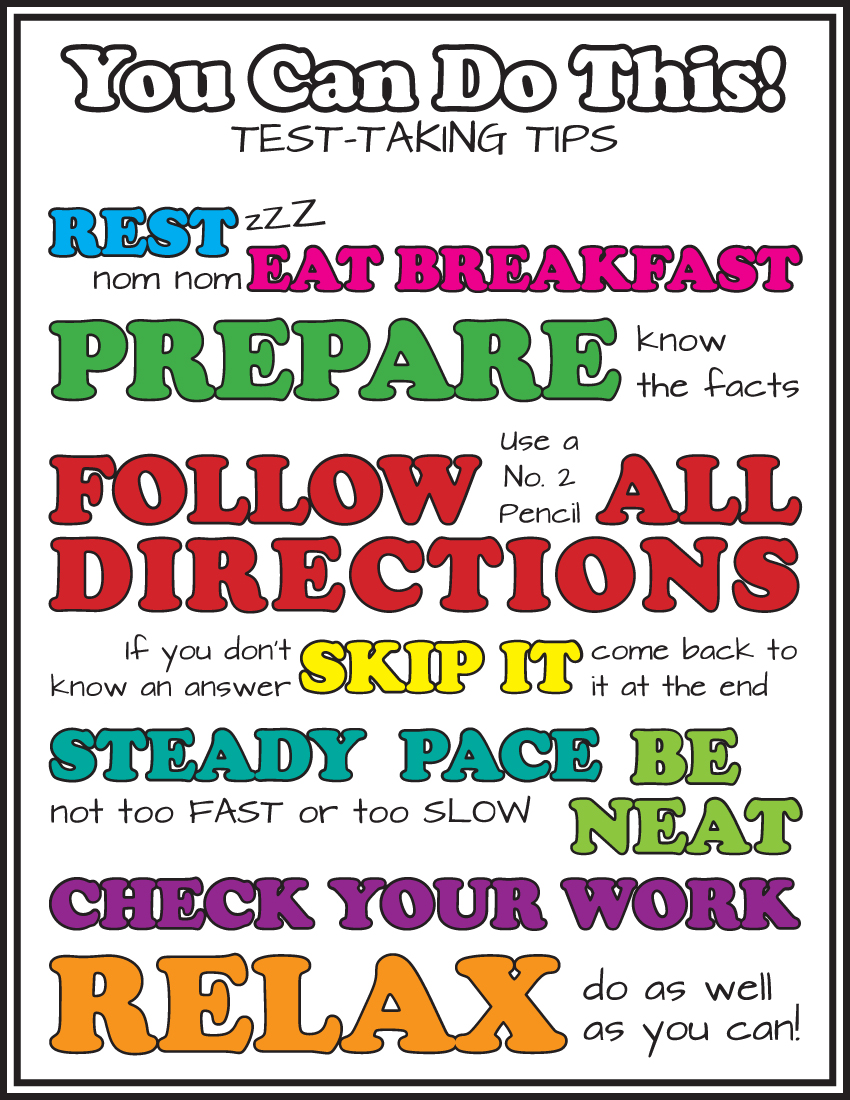 |
| Click here to download this poster. |
• Have student turn finished tests in to the back of the classroom. This can be less distracting for students still taking the test and lessen any anxiety they may have for not finishing as quickly as their peers.
• Get the wiggles out between tests: jumping jacks, stretching, pencil sharpening, bathroom break, etc.
• Celebrate when testing is finished! Get party ideas from our Party Time! Pinterest board for great ideas.
Need some more help?
Check out Remedia's materials geared towards improving test-taking skills.
Test Taking Tips
Download the FREE You can do it! Test-Taking Tips poster and bonus activity.
How to Improve Students' Critical Thinking Skills

Improve high-level, critical thinking skills and you're sure to improve reading comprehension, problem solving, writing skills, and more! We’ve gathered five important higher-level thinking skills, defined the skill, and suggested a way for you to help improve that skill. These tips are a terrific way to give your students the tools they need for success in school as well as in their daily lives!
The Penny Project

What you'll need:
- Letter-Size Manila Folder - one for each student, or divide students into groups of two
 What to do:
- Reproduce this Lincoln patter <free download> for each student or group to cut, color, and past to the front of their penny folder.
- On the inside of the folder, have students trace a penny, making 25 circles. You can change this based on the project you choose to do, see below for details.
- Have students start collecting pennies. Challenge students to
a) find a different penny for each year, for the last 25 years; b) to find a penny from 25 different years. - As students find pennies, tape or glue them in place. Encourage students to put their coins in order of year, oldest to newest.
- Students should write the year under each coin.

Meet the Standards
- Display the coins in a timeline. (CC.W.2.a)
- Research five of the 25 years that their coins represent.
- What is one significant thing that happened in each of the five years? (CC.W.8)
- Make a timeline showing highlights from each of the five years. (CC.W.2.a)

- Ask students to find a coin from the year they were born. Then ask:
- Who was president that year? What are some similarities and differences between that president and the current President? (CC.RI.5)
- Research to find what the latest technology during President Lincoln’s time was. Compare that to latest technology from the year you were born? (CC.RI.5)
- Challenge students to find the oldest penny. Offer a reward (of your choice) for the student who finds the oldest coin. Then have students:
- Write a report highlighting events from that year. (CC.W.2)
- Make a timeline showing highlights from that year (CC.W.2.a)
- Have students find a penny from significant times in history. Hold student's attention by making the specific dates both educational, fun, and relatable. Based on their research or prior knowledge, students will know what years to find. (CC.W.7)
Examples:
- Barack Obama inaugurated as 44th president (2009)
- The book Harry Potter and the Sorcerer's Stone came out (1998)
- Space shuttle Challenger exploded (1986)
- Ronald Reagan inaugurated as 40th president (1981)
- First cellphone was used (1973)
- Martin Luther King, Jr. delivered his, “I Have a Dream Speech” (1963)
 |
| Bonus Research Question: Why does Lincoln face a different direction on the penny? (CC.W.8) |
As students collect research and complete other Lincoln projects they can keep everything in their Penny Project Folder.
Tip: Because this project is perfect for Presidents' Day, you could have students do this same project with George Washington and quarters. Split the class in half so that some students create a Penny Project Folder and some students make a Quarter Project Folder.
Abraham Lincoln Freebies
Use the free worksheets below to build student's knowledge of Abraham Lincoln. As students complete the worksheets have them add each to their Penny Project Folder.
All About Abe - Reading Comprehension Worksheets
Abraham Lincoln's World - Research Skills Worksheet, Using an Almanac
Equality Freebie - Critical Thinking Worksheet
5 Lessons of the Heart

Getting to Know the Heart
Familiarize students with the parts of the heart with this free labeling activity from our Labeling for Comprehension Series. Students will read a short description of the heart, and then demonstrate their understanding by labeling the diagram. Now, they are ready to get their blood flowing with the next two activities.
A Blood-Pumping Graphing Activity
Integrate math, health, and heart-healthy science with this blood-pumping activity. Students will graph their heart rates while doing different activities.
1. Ask students, “Did you know that your heart is a muscle? In fact, it is the only hollow muscle in your body. Like all the muscles in your body, your heart stays strong when it exercises. Let’s see how exercise makes your heart work and keep strong.”
2. Have students find their pulse while sitting at their desks (resting heart rate). Have each student gently press their forefingers to their wrist, near the base of the thumb. Have them count the pulses while you keep time for 15-seconds. Then each student should multiply their count by four to get the beats-per-minute. Have students write this number in this chart (free download).
3. Complete the chart together as a class. After each activity, have students take their pulse. You’ll be in charge of the clock, tracking the intervals, and making sure students stay on-task. When you are done, have students create a bar graph or line graph to show how their heart rate differed for each activity.
4. Explain to students that blood is a special “belt” that brings oxygen to the muscles and carries the bad away, and you want your heart to be in its best shape to do this well.
A Field Trip Through the Heart
Good News! This field trip does not require a permission slip. Students will take a trip through the heart right in your classroom.
- With tape, draw a large diagram (click here to download) of the heart on our classroom floor. This diagram includes a station for the lungs and body cells.
- Label the chambers of the heart, the lungs, the body cells, and all blood vessels accordingly.
- Place large blue circle cutouts in the body cells and large red circle cutouts in the lungs.
- Have a small group of students be the “blood” moving along the route through each station like blood flowing through the heart.
- Have two students be the “lungs” in the lung station.
- Have a few students act as the “body cells” in the body cells station.
- Narrate what the blood is doing as the students go through each stop.
- Explain what blood vessel they must take.
- As students reach the body cells station, have students exchange their red circles (blood cells carrying oxygen) for blue circles (blood cells carrying carbon dioxide).
- As students pass through the lungs, have them exchange their blue cells for red cells, which illustrates the diffusion of oxygen into the blood. Point out that blood vessels carrying blood away from the heart are arteries, and usually carry red blood. Blood vessels carrying blood towards the heart are veins, and usually carry blue blood.
- Also point out that the right side of the heart handles blue blood and the left side of the heart handles red blood.
Use these free worksheets <free download> before students take a trip through the heart to give a little background knowledge of the heart and cardiovascular system. These worksheets come from our The Human Body: Digestive, Circulatory, Reproductive, & Excretory Systems book.
Secret Valentine Exchange
Finish your heart-throbbing unit with a Secret Valentine Exchange. This activity is still science-focused while incorporating language skills.
1. Put every student’s name in a bag, and have each student draw a name from the bag.
2. Have students color and decorate this free heart template using red and blue crayons, construction paper, or magazine clippings to properly indicate where the red and blue blood cells flow.
3. On the back of each heart ask to students “pour their hearts out” to their Secret Valentine using heart-themed idioms or proverbs, such as: heart pumping, change of heart, heart misses a beat, heart bleeds, with a heavy heart, eat your heart out, from the bottom of my heart…etc.
Use this opportunity to encourage students to work on their handwriting, poetry, and/or creative writing skills. On V-day, have students share their heart (pun intended) with the whole class and reveal who and why they think their Secret Valentine has a heart of gold.
Freebies from the American Heart Association
Check out The American Heart Association who makes a variety of educational lessons, posters, activities, and other great freebies to support your heart lessons.
7 Get-Up-&-Move Math Activities

 Bowling Math
Get an inexpensive bowling kit from the toy section and set up a lane or two in your classroom. On the bottom of each pin write numbers (depending on your student's level make the numbers as small or large as you'd like). Have students take turns rolling the ball down to the pins. After one student rolls the ball down to the pins, have that student walk, lunge, or skip down to the pins. Have that student add up the numbers on the bottom of their pins--that's their score for that round. If you'd rather not keep score, just have students work the math problem. They can either add, subtract, or multiply all of the numbers or just the two largest numbers.
Active Stations
As students make their way through your normal math stations, have them do lunges, crab walking, or wheel barrels to get to the next station.
Bean Bag Toss
Use these simple instructions (from Dirt & Boogers Blog) to make your own Bean Bag Toss easily and with very few materials. Adjust the design with a few extra holes to make this game educational. Simply cut several holes into the box and label each hole with a number. Give students a math equation and have them toss the bean bag into the hole with the correct answer. Or assign word problems to each number. Whichever hole the bean bag lands in, that is the word problem the student must answer.
5 Gift-Themed Activities

Gift Stations ~ Math
Fill several different size boxes with random dollar store gifts and wrap them or use the dollar store gift boxes--no wrapping necessary. Then, put the gifts at different gift stations: one station for measuring, one for weighing, and one for word problems. Split students into groups and rotate them through each gift station. Have students work together to answer the questions you’ve left at each gift station.
Word Problems Gift Station: Tape a word problem to the bottom of each gift. Ask students solve one or all of the problems on each gift. Or to further challenge your students, ask them to determine which gift is the largest or heaviest, and then have them only answer the word problem on the bottom of that gift.
Measurement Gift Station: Ask students to measure each box’s width, height, length and determine which is the largest, smallest, and tallest gift.
Weight Gift Station: Do the same as the Measurement Stations with weight related questions.
Celebrity Gift ~ Writing
Because gift giving is so special, it should take a lot of thought and planning. Ask students to think about what they might give to their favorite celebrity or character from a book. They can pick the celebrity or have students pick one person from list. Then have write about the gift they would give. Ask student to describe the gift and why they chose it for that person.
Celebrity Suggestions: Santa Clause, the President, Walter Payton, J.K. Rowling, Miley Cyrus, One Direction, Bart Simpson, Justin Timberlake, Katniss Everdeen (The Hunger Games).
For more inspiration and mini biographies to help students know what to choose as a gift, have students read any one of our Celebrity Readers stories.
Candy Corn Activities

5 Non-Reading, Inference Activities

Making inferences means using facts and reasoning to come to a decision or an opinion about something. Doing this involves an abstract level of thinking and can, therefore, be a complicated skill to teach, especially to students who struggle with reading. With practice though, students can become comfortable with the skill before having to tackle the concept while reading. These five activities will give your students a chance to practice making inferences without reading.
Money-Saving Tips for Teachers

Save in the Classroom
- Have parents donate a book to your class library in lieu of bringing cupcakes on their child’s birthday. Write the student’s name, birthday, and year on the inside cover so you and all of your students will know who the book was celebrating.
- Use plastic plates as individual dry-erase boards for each student--they are reusable and less expensive than a personal white board (and you can usually find them at the dollar store!).
- Invest in fade-proof paper to back your bulletin boards. It will last all year.
- Apple, Disneyland, Barnes & Noble, and many of other retailers offer teacher discounts--be sure to ask about them!
- If you’ve used your teacher discount to purchase an iPad, take advantage of the thousands of digital children’s picture books that you can read to your students from your iPad. For a low price, you’ll have these books forever with no torn pages.
- Don't be shy--ask for donations! One of our Facebook Fans, Lisa, suggests this site: Donors Choose.
Subscribe to:
Posts (Atom)