Game Show Games with an Educational Spin

3 Game Show Games with an Educational Twist | Remedia Publications
We all love a good game show! Next time you’re looking for ways to spruce up your game-play in the classroom, try watching your favorite game show and then modify the games for your classroom. This is not a new concept; it has been done for years with shows like Jeopardy and Family Feud. And now we’ve done it with three games that are spin-offs of NBC's Hollywood Game Night classics.  

If you're not familiar with it, the show brings together two awesome components—games and celebrities. We’ve simply put an educational twist on a few of Hollywood Game Night's very simple games so that you can use them to review just about any subject in your classroom. You probably won't have the celebrity guests, but you can definitely have fun! Bonus…these games require very few materials. Each game will require you to have a writing utensil (shock!) and a timer (a watch will do just fine).

Want more reasons to start playing games in the classroom? Read this!

Off the Top of My Head Materials: Sticky-Notes, Marker, & Timer

Split the class into at least two teams. Each student will have a sticky note on his or her forehead. Each sticky note has a review word, phrase, punctuation or grammatical term, math formula, historical figure, book character, or whatever you might want to review written on it. Everyone can see what is on the sticky note, except for the person wearing the sticky note.

Have one team play at a time. Depending on how many students are in each team, assign a time limit, like 90 seconds. Each team has that much time to try and get through as many sticky notes as possible. Have team members line up. The person at the front of the line turns to face the person behind him. That person gives the guesser clues to help him figure out what the sticky note on his own forehead says. Once the guesser gets the answer, he moves to the front of the line and turns around to begin giving clues to the person who was behind him. The person who was giving clues goes to the end of the line. Each correct answer is worth one point.

Watch how this game is played on Hollywood Game Night.

10 Real-World Activities that Support Your Curriculum

 
When it comes to getting your students' attention, and keeping it, making your lesson as relatable as possible is key. Turn what kids already find entertaining, like going to the movies or texting, into learning experiences, and they'll meet the challenge head on! And they'll have fun doing it! Here are 10 tips to supplementing your daily lessons with real-world kid experiences.
 

  1. Have students text a summary of the story they just read to a friend in the class and then share their friend’s summary with the class. This will really help them to make a summary brief and to the point.

  2. For book reports, have students write a review of the book on their Facebook page. This may even prompt discussions about the book with their peers. Have them print their review and discussions to include in their book report.

  3. Take a picture of your mall’s directory and post it on your whiteboard to teach mapping skills. “Travel” through the mall with your students. Have students write directions from one store to the next store.  Find the pet store. How would you get there from here?

  4. Follow-up your lessons on fact and opinion with some previously recorded TV commercials. Have students divide a piece of paper into 2 columns, labeling one as "facts" and the others as "opinions". As students watch the commercials, they'll quickly see that there are probably more opinions in commercials than facts!

5 Math Activities Using Repurposed Magazines

5 Math Activities Using Repurposed Magazines | Remedia Publications

Before you toss your TV Guide, People, or Every Day with Rachael Ray in the recycle bin, read these tips for repurposing old magazines.  That pile of magazines has great activities to support your math lessons!

Magazine Math
  1. Have students cut colorful pictures from magazines and paste them onto a piece of construction paper use this template <free download>. Underneath the collage of magazine clippings have students write a math word problem related to the picture they’ve created. Have students carefully proofread their work for errors. Also have them answer the word problem and write the answer on the back of the activity. Then have students share their word problem with a classmate to solve. Post the colorful word problems on your bulletin board for an eye-catching math board.
  2. Go on a magazine scavenger hunt! You can modify this concept for any subject, but for the sake of math related activities, focus on your current lesson plan. For example, have students find: a line longer than two inches, a number in words, a percent, a pie chart, a bar graph, a date, a cylinder, a right angle, and so on.  Instruct students to find an example of each in a magazine, cut out the example, and glue them to a piece of construction paper. This would also make for a colorful math bulletin board!
  3. Start clipping and saving the recipes printed in magazines for your next fractions lesson. Provide each student with a recipe. Challenge students to double, triple, or cut the recipe in half.  For a hands-on approach, give students only three measuring cups, for example: ½ teaspoon, ½ tablespoon, and ¼ cup.  Have students determine how to make the recipe with just those measuring tools.  If the recipe calls for 3 cups of flour, how many ¼ cups will you need?

  4. Local city magazines are typically free and easy to find, plus they are always packed coupons to local restaurants. Provide each student with a coupon and ask them to identify how much they must spend in order to redeem the coupon and if they spend x amount of money, how much will they save by using the coupon?  To give students a hands-on experience, give each student different amounts of play money. Have them deduct the coupon’s discount amount from their stack to see what 10% looks like versus deducting $10.

    Real estate advertisements are also common in local magazines. These advertisements often market a square foot price (i.e. $0.50/sf). Ask students to determine how much a building would cost of if the square footage was 7,000 sf. Or if the square foot price and the total price are listed, ask students to determine the size (sf) of the building.

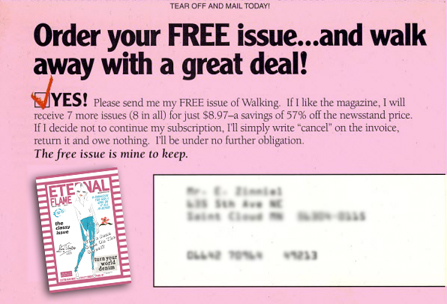
  5. Save the postcard-size blow-ins that sell magazine subscriptions. See example below. Give each student a postcard.  Ask students to find, or determine using math, the following information from the postcard: magazine name, regular subscription price, single magazine price, number of issues, and special subscription price.  Have students determine the savings per issue, the price per issue with savings, the annual price of the in-store magazine versus the subscription price, etc.

5 Math Activities using Repurposed Magazines | Remedia Publications

Get Your Class Up & Moving with these Fun Activities

Get Your Class Up & Moving with these Fun Outdoor Activities | Remedia Publications
Use these fun activities to get get your class up and moving this year. Your students will love the change of pace and gain the healthy benefits of moving around.

Math Races
Put math word problems on index cards. Split your class into teams of four. Take your class outside to the football field. Have each team of four split into twos so that two students stand lined up 30 yards across from the other two students in their team. Hand out an index card to each pair closest to you. On your "Go!" students race to their teammates with the question in-hand. As a group, the teams of four will work together to answer the word problem. As soon as a team has the answer, the second pair run the answer back to you. The first team back to you with the correct answer gets a point. Repeat!
Modify this activity by having students do lunges, skipping, or crab walks instead of running back and forth.

Reading Races
Similar to the game above, hand out short reading comprehension stories instead of a math problem. We suggest using our Specific Skill Builders--these short, high-interest stories are captivating and can be grouped by reading level. Plus the questions are already done for you. Have each team of four split into twos so that two students stand lined up 30 yards across from the other two students in their team. Hand out a story card to each pair closest to you. On your "Go!" students race to their teammates with the story and question in-hand. One student on each team should take a turn reading the story out loud to the group. As a group, the teams of four will work together to answer the comprehension question. As soon as a team has the answer, the second pair runs the answer back to you. The first team back to you with the correct answer gets a point. Repeat!

The Benefits of Playing Games in the Classroom

Playing Games in the Classroom | Remedia Publications

There's a lot of game playing going on in the classroom these days, and we think that's pretty awesome! Are you among the 67% of teachers using traditional and digital games in their classrooms?